
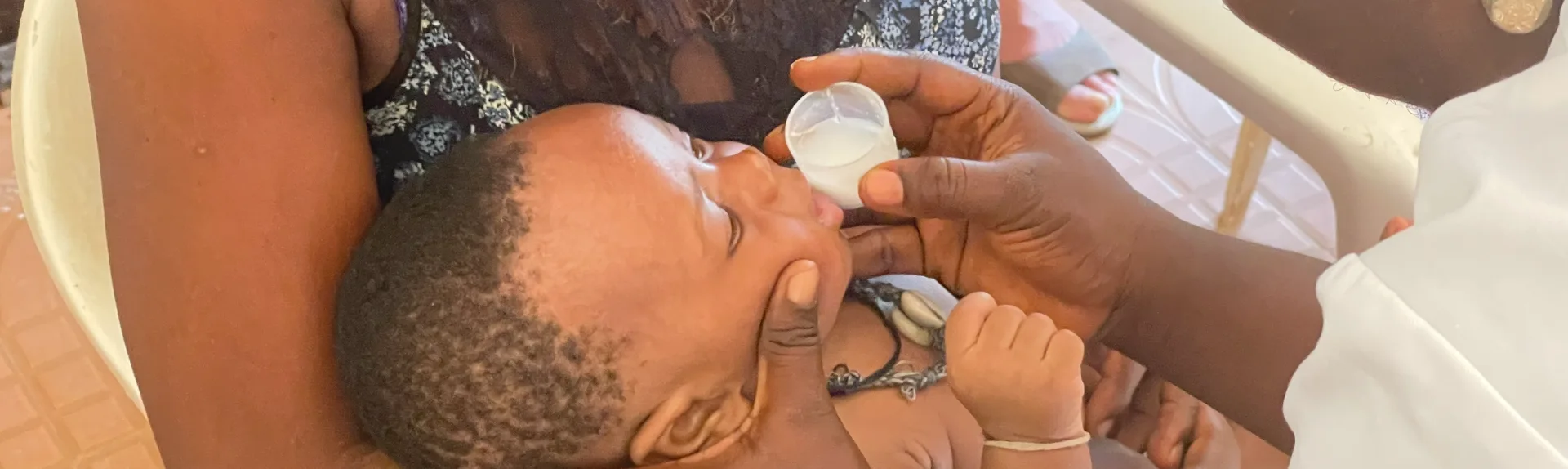

We improve child health by optimising health systems in Sierra Leone, where there's a high infant mortality rate from this disease.
What we do
”la Caixa” Foundation promotes the programme to fight malaria known as ICARIA, an acronym that stands for "Improving Care through Azithromycin Research for Infants in Africa", with the aim of evaluating the impact of azithromycin administered through the Expanded Program on Immunization in addition to IPTi-SP on mortality in children under 18 months of age in Sierra Leone.
Why we do it
Half the 5.4 million children under 5 who die each year in the world live in the African region, where falciparum malaria is one of the major causes of death.
Intermittent preventive treatment of malaria in infants (IPTi), consisting of the administration of sulfadoxine/pyrimethamine, is a safe, efficacious and cost-effective intervention in reducing malaria.
Despite the WHO recommendation (2010) to administer IPTi alongside routine vaccinations in areas of high to moderate perennial transmission, this treatment is not implemented in most African malaria-endemic countries.
Recent studies carried out in some African countries show that azithromycin (AZi) is also associated with a significant reduction in child mortality when used for mass drug administration in the elimination of trachoma.
Evaluation of the impact on mortality reduction of the addition of AZi to IPTi (ITPi+) and assessment of bottlenecks for IPTi scale-up are needed before promoting their large scale-up.
Goals
Overall goal:
To assess the impact of azithromycin administered through the Expanded Program on Immunization in addition to IPTi-SP on mortality in children under 18 months of age in Sierra Leone.
Specific goals:
To assess the impact of azithromycin plus intermittent preventive treatment with sulfadoxine-pyrimethamine administered through the Expanded Program on Immunization on mortality in children under 18 months of age living in areas of high malaria endemicity and mortality burden in sub-Saharan Africa.
To identify bottlenecks in the implementation of intermittent preventive treatment with sulfadoxine-pyrimethamine administered through the Expanded Program on Immunization in Sierra Leone.
How we do it
To this end, we conducted an individually randomised, placebo-controlled trial of intermittent preventive malaria treatment in breast-feeding infants (IPTi) plus azithromycin (AZi) in 20,560 breast-feeding infants exposed to a high malaria endemicity and mortality burden in Sierra Leone.
This approach will help to provide conclusive evidence of the effect of IPTi together with AZi in reducing under-5 mortality rates and address the gaps in knowledge and implementation to scale up ITPi/IPTi+.
Since 2019, 20,560 children have been participating in this programme.
Where we act
In 15 primary care centres in the districts of Bombali, Port Loko and Tonkolili in Sierra Leone.
More information
If you'd like find out more about the ICARIA programme, visit the ISGlobal website.
You may also be interested in
ISGlobal (Barcelona Institute for Global Health) leads a consortium that includes the Faculty of Medicine and Allied Health Sciences (COMAHS), the Ministry of Health and Sanitation of Sierra Leone and the Hospital Clínic de Barcelona, which will manage the macrolide resistance assessment, and the Hospital Sant Joan de Déu (HSJD), which will coordinate the Safety Monitoring component. The programme, which includes a 5-year clinical trial in different districts of Sierra Leone, is also financially supported by the Bill & Melinda Gates Foundation.